
Industry Update: Natural vs. Synthetic Iron Oxide Pigments in Modern Industrial Coloring
Date Published
Natural vs. Synthetic Iron Oxide Pigments in Modern Industrial Coloring
Iron oxide pigments remain one of the most widely used classes of inorganic colorants across construction materials, coatings, plastics, and ceramics. While both natural and synthetic forms share the same basic chemistry—primarily iron oxides such as Fe₂O₃ and FeOOH—their production methods and performance characteristics differ significantly in industrial applications.
Natural iron oxide pigments: variability and limitations
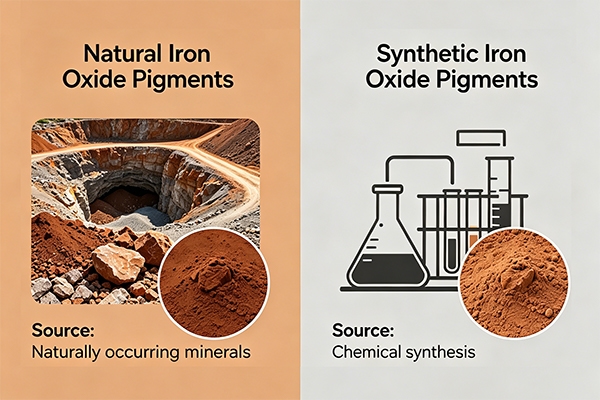
Natural iron oxides, commonly known as ochres, are obtained directly from mined mineral deposits. These materials have been used for thousands of years in coloring applications due to their availability and basic stability.
However, in modern industrial manufacturing, natural pigments present several challenges:
- Inconsistent composition: Natural deposits often contain varying levels of impurities such as silica, alumina, or other metal oxides, leading to color fluctuations between batches.
- Limited color control: Achieving precise shades is difficult due to the inherent variability of mined material.
- Lower tinting strength: Compared to engineered products, natural pigments typically require higher dosage levels to achieve the same color intensity.
- Supply dependency: Quality and availability depend heavily on mining location and geological conditions.
As a result, natural iron oxides are now used less in high-performance industrial systems where consistency is critical.
Synthetic iron oxide pigments: engineered precision and performance
Synthetic iron oxides are manufactured through controlled chemical processes such as precipitation, thermal decomposition, or oxidation of iron salts. This allows precise control over particle size, phase composition, and purity.
Key advantages include:
- High purity and consistency: Synthetic production eliminates many of the impurities found in natural ores, ensuring uniform color from batch to batch.
- Wide color range and reproducibility: Reds, yellows, blacks, and browns can be engineered with consistent hue and tone, supporting large-scale industrial standardization.
- Stronger tinting strength: Fine and uniform particle distribution improves color efficiency, reducing the amount needed in formulations.
- Excellent dispersibility: Controlled particle morphology enhances compatibility with binders in paints, plastics, concrete, and coatings.
- Enhanced performance stability: Synthetic iron oxides provide superior resistance to UV exposure, weathering, and chemical environments.
Industrial preference and application trend
In modern industries—particularly architectural coatings, concrete coloring, polymer masterbatches, and automotive materials—synthetic iron oxide pigments have become the preferred choice due to their reproducibility and technical reliability.
Natural iron oxides still retain niche applications where traditional aesthetics or lower processing requirements are acceptable. However, for industries requiring strict color standards and scalable production, synthetic alternatives provide a clear technical advantage.
Conclusion
The transition from natural to synthetic iron oxide pigments reflects the broader evolution of industrial coloring—from resource-dependent variability to engineered precision. Today, synthetic iron oxides enable manufacturers to achieve consistent, durable, and high-performance coloration across a wide range of demanding applications.
As a manufacturer of synthetic iron oxide pigments, we continue to focus on delivering stable quality, controlled color performance, and reliable supply to support modern industrial needs.